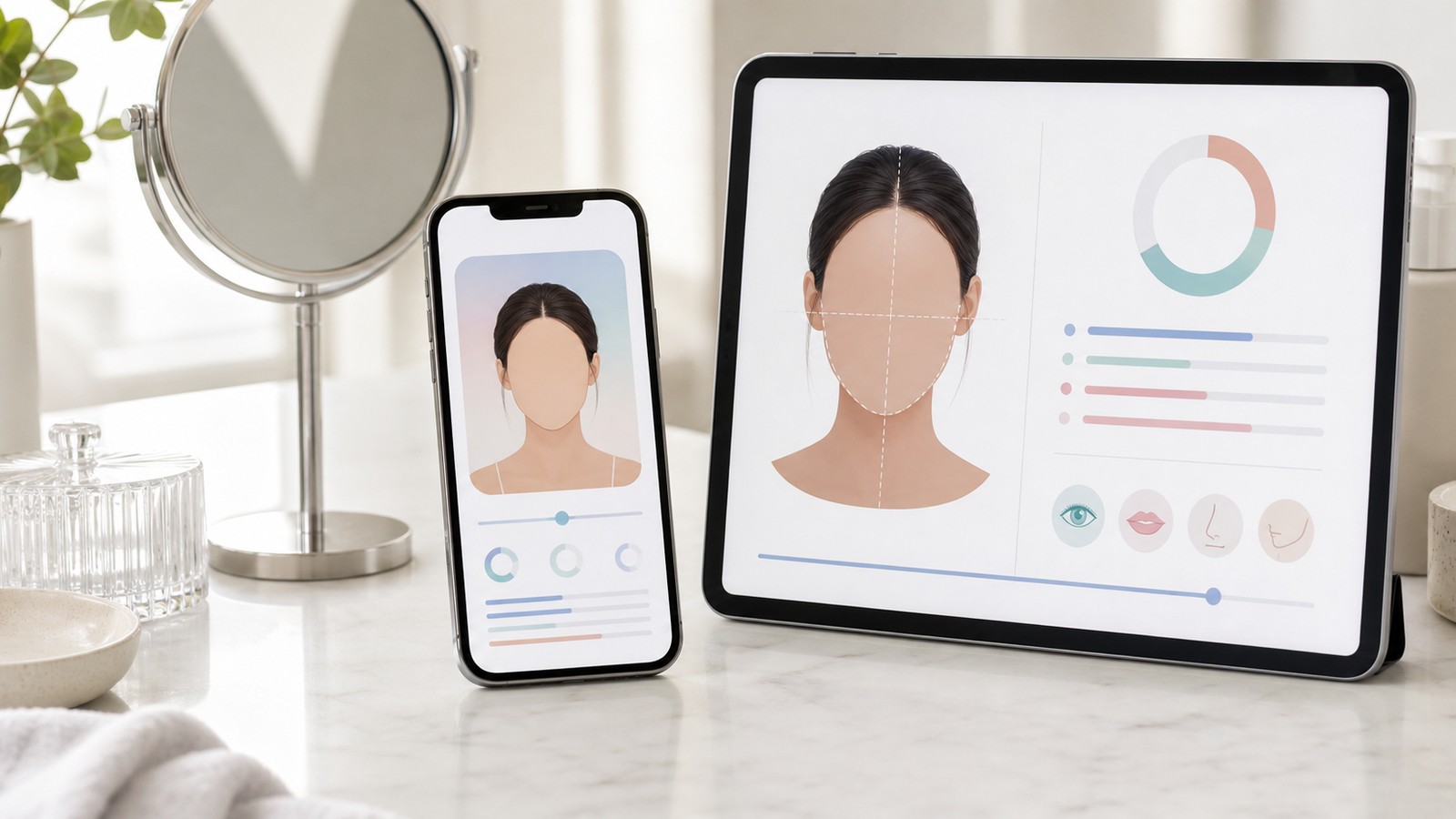
Face Score Calculator
Try the free face score calculator and read your result with percentile context.

There is no universal average beauty score that applies to every app, website, country, dataset, or model. Each tool uses its own scale and reference distribution. That is why FaceScore shows more than a raw number: after you upload a face photo, the result includes a 100-point beauty score and a percentile-style Top % that explains where the photo sits inside FaceScore's own reference range.
If a tool gives you 62/100, the useful question is not whether 62 is above a fixed global average. The useful question is where that result lands in the tool that produced it. FaceScore's percentile answers that directly. As a rule of thumb, 70/100 reads roughly like a 7/10, but the Top % is the stronger context because it shows the result relative to the model's distribution.
FaceScore uses a 100-point scale because it is familiar and easy to compare. A single number lets you quickly see whether one photo scored higher than another. But the number is only part of the result. A top percentage, such as being in a stronger relative range, can make the beauty score easier to interpret. If you only look at the score, you may assume too much. If you read the score and percentile together, the result becomes more practical.
The average can also help with expectations. Some users see a score and immediately compare it to idealized images online. That is not a healthy or accurate way to use a face rating tool. FaceScore is more useful as a personal photo feedback system. You can ask: which photo reads most clearly? Which one gives a stronger top percentage? Which one also feels like the image I want to share? These questions are more helpful than trying to turn the beauty score into a fixed label.
Percentile answers the question a raw score cannot answer on its own: is 62 good? Alone, the number is hard to judge. As "Top 35%", it becomes clear: the uploaded photo scored higher than 65% of reference results. That is why FaceScore pairs the 100-point score with a Top % instead of leaving you with a number and no context.
That distinction also reduces confusion if you arrive with a fixed idea of "average." A face rating average can vary by website, country, dataset, and model. In FaceScore, the average is tied to the system that produced it. The useful question is how FaceScore reports its own result and whether the score is consistent across several clear photos.
It is also important to remember that FaceScore analyzes a photo upload, not a person in every situation. The same person can receive different scores from different photos. A bright, sharp portrait may score better than a dark, blurry image. A relaxed expression may read better than a tense one. A front-facing crop may produce a clearer result than an extreme angle. These differences do not mean the person's appearance changed. They mean the image gave the model different information.
For this reason, the best way to understand your beauty score average is to test several similar photos. Choose images with comparable lighting and framing. Avoid using one formal portrait, one party photo, one filtered image, and one distant group shot as if they are equal inputs. If you want to compare fairly, keep the conditions close. Then look at the range of results. If several photos cluster around a similar score, that range may be more informative than one result.
If your result is below what you expected, try improving the photo before judging the number. Use softer light, reduce blur, keep the face visible, and avoid strong filters. A better photo can make the face score more stable. If your result is higher than expected, treat it as a strong signal that the model read that uploaded image favorably and use it when choosing a profile-photo candidate.
In short, beauty score average is about context. A raw number alone can be hard to read. A percentile and top percentage make the result easier to understand. FaceScore gives you both, from a simple photo upload, so you can compare images, understand the score range, and use the result as a practical photo-selection reference.
There is no universal average beauty score. Every tool uses its own scale and distribution, so FaceScore is best read through the percentile and Top % shown in the result. Top 30% means your photo scored higher than 70% of reference results.
No. A single score is only an estimate from one uploaded photo. Lighting, angle, and expression can affect the result.
Percentile and top percentage give context, making the face score easier to interpret than a raw number alone.
No. An average face symmetry score focuses on symmetry, while a beauty score average in FaceScore is read with the 100-point score, percentile, and top percentage.
Yes. Comparing similar photos can help you understand which image reads better to the face rating model.
No. It also works as a face score tool, beauty calculator, rate my face AI check, and profile-photo comparison reference.